Table of Contents
- Chainsaw Return Policy for Damaged Items: The Short Version
- Faulty Product Consumer Guarantees in Australia: What You’re Actually Owed
- Shipping Damage, Manufacturing Defect or Your Own Fault?
- How to Report Damaged Goods to a Retailer: Step by Step
- Evidence for a Damaged Delivery Claim: The Chainsaw Checklist
- Damaged Item Return Email Template You Can Copy
- Return Shipping, Deadlines and What Happens Next
- Frequently Asked Questions
Last Updated: October 19, 2026
Chainsaw Return Policy for Damaged Items: The Short Version
A damaged chainsaw is not a dead loss. This guide from Chainsaws R US walks you through the chainsaw return policy for damaged items, from first photo to final refund.
Here is the short version:
- Stop using the saw immediately. Do not fuel it, charge it, or start it.
- Photograph everything before you move the box or the unit.
- Contact the seller in writing and keep a copy.
That last point matters. A common mistake is paying for return postage out of your own pocket and then trying to claim it back later.
Below: what you are owed, how to tell shipping damage from a manufacturing fault, and the evidence a retailer needs to approve a claim fast.
Faulty Product Consumer Guarantees in Australia: What You’re Actually Owed
Faulty product consumer guarantees in Australia come from the Australian Consumer Law, inside the Competition and Consumer Act 2015.
The ACCC guide to consumer guarantees sets out the core rule: goods must be of acceptable quality, fit for purpose, and match their description. A chainsaw that will not start out of the box fails that test.
What you are owed depends on how badly the product fails.
Major Failure vs Minor Problem: Which Remedy Applies
A major failure is when the product would not have been bought by a reasonable person if they had known about the fault, or when it is unsafe, or when it simply cannot do what it is meant to do.
A minor problem is something that can be fixed quickly and cheaply, like a loose cover or a missing accessory. Here the seller may choose to repair it.
| Situation | Failure type | Who chooses the remedy |
|---|---|---|
| Saw will not start at all | Major | You: refund or replacement |
| Chain brake does not engage | Major (safety) | You: refund or replacement |
| Missing scabbard or tool kit | Minor | Seller: repair, replacement part, or refund |
| Bar oiler blocked on first use | Minor to major | Depends on how serious and how fixable |
| Cracked housing from transit | Major | You: refund or replacement |
Do not let a retailer talk you into a repair when the failure is major. If the saw is unsafe or fundamentally unfit, you are entitled to say no to a repair and ask for your money back or a new unit.
Shipping Damage, Manufacturing Defect or Your Own Fault?
The cause of the damage decides who pays and how fast the claim moves.
Shipping damage shows up as crushed corners, punctured cartons, cracked housings, or a bent bar.
Customer-caused damage is a drop, a wrong fuel mix, or a bent bar from a pinch.
What most guides miss is that the cause is rarely proven by argument. It is proven by photos taken in the first ten minutes.
How to Report Damaged Goods to a Retailer: Step by Step
Reporting damaged goods to a retailer is mostly about timing and records. Move fast and keep everything in writing.
- Stop and do not use the saw. Using it can turn a clear transit claim into a disputed one.
- Photograph the carton before opening further. Capture every side, the shipping label, and any crush marks.
- Photograph the saw itself. Show the damage close up and in context.
- Note the serial number and order number. These tie the claim to your purchase.
- Contact the seller in writing within a reasonable timeframe. Same day or next business day is best.
- State the remedy you want. Refund or replacement if it is a major failure.
- Ask for a prepaid return label or freight collection. Do not agree to pay postage first.
- Keep the packaging until the claim closes. You may need it for the return.
Send your claim by email rather than phone. A written record with timestamps is far stronger if the claim is later disputed, and it forces the seller to respond in writing too.
Evidence for a Damaged Delivery Claim: The Chainsaw Checklist
Strong evidence separates a fast approval from a drawn-out argument. Retailers approve claims quickly when the file is complete and the cause is clear.
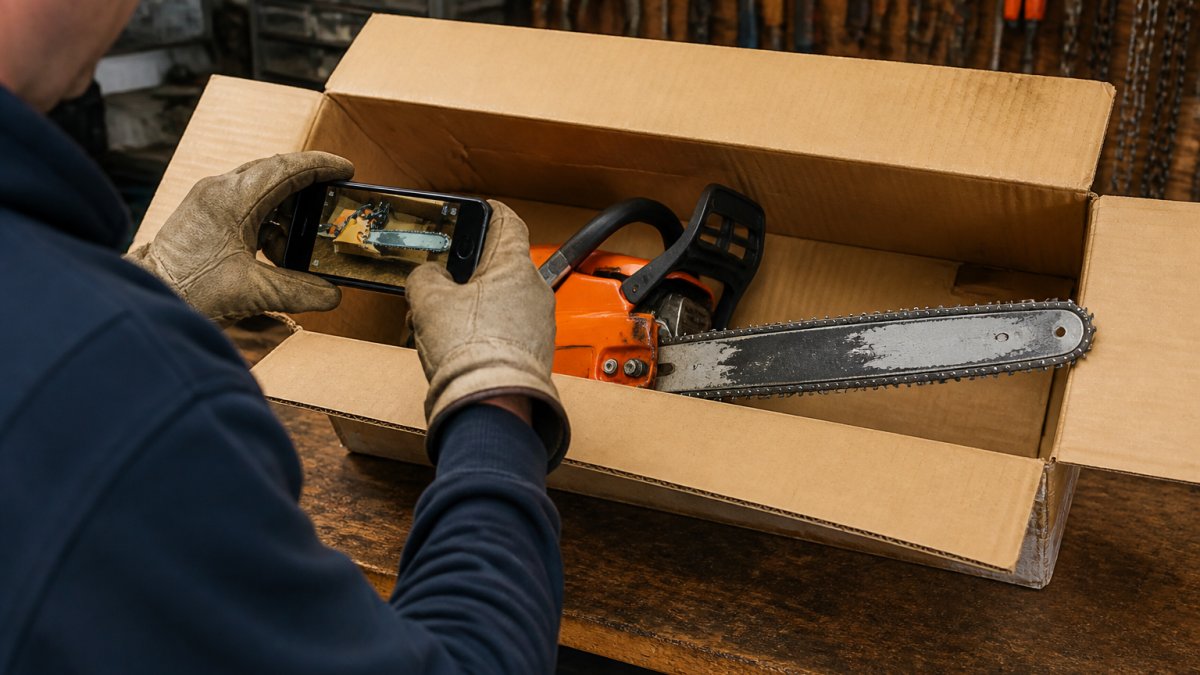
Use this checklist before you contact anyone:
- Photos of all six sides of the carton
- Close-up of any crush, puncture, or water mark
- Photo of the shipping label and tracking number
A short video of you opening the box, if you filmed it, is the strongest single piece of evidence. If you did not, the photo set above still does the job.
Chainsaw-Specific Inspection Sequence
Before you assemble or fuel the saw, inspect these areas in order and photograph anything that looks wrong:
- Bar and chain – Look for a bent bar, a chain that will not sit in the groove, or missing drive links. A bent bar is often shipping damage; a chain that will not tension on a straight bar points to a manufacturing defect.
- Housing and covers – Check for cracks, scuffs, and misaligned seams. A cracked housing with a crushed carton is transit damage; a crack with no packaging marks is harder to attribute.
- Controls and safety devices – Test the chain brake, throttle lock, and stop switch by hand before starting. A brake that will not engage is a safety issue and should be treated as a major failure.
- Fuel and oil systems – Look for leaks, cracked tanks, or missing caps. Do not add fuel to check.
- Accessories – Confirm the scabbard, tool kit, and manual are present. Missing accessories are usually a minor problem.
Telling Shipping Damage from a Manufacturing Defect
The cause decides who pays and how fast the claim moves.
Shipping damage shows up as crushed corners, punctured cartons, cracked housings, or a bent bar.
Customer-caused damage is a drop, a wrong fuel mix, or a bent bar from a pinch.
What most guides miss is that the cause is rarely proven by argument. It is proven by photos taken in the first ten minutes.
Safe Handling of a Damaged Chainsaw Before You Ship It Back
A damaged chainsaw can still be dangerous. Treat it as unsafe until proven otherwise.
- Drain the fuel into a proper container before transport, and never ship a saw with fuel in the tank.
- Remove the battery from a cordless unit and ship it separately where required.
- Fit the bar cover or wrap the bar and chain in cardboard.
For fuel-powered saws, carriers often refuse units with fuel residue, so drain and air the tank first. For battery saws, check the carrier’s rules on lithium batteries before you book anything.
Damaged Item Return Email Template You Can Copy
A clear, factual email gets a faster response than an emotional one. Adapt this damaged item return email template.
Subject: Damaged on arrival – Order [number] –
Hi [seller name],
I received order [number] on [date]. The arrived damaged. The outer carton had [describe crush/puncture], and the saw itself has [describe damage].
I have attached photos of the packaging, the damage, and the serial number.
This looks like a major failure, so I am requesting a [refund / replacement].

Keep it short, attach the photos, and state the remedy you want.
Return Shipping, Deadlines and What Happens Next
Return shipping for a faulty item is the seller’s cost under the consumer guarantees, not yours. If the saw arrived damaged, ask for a prepaid label or freight pickup before you send anything.
Chainsaws add a layer most return guides ignore: dangerous goods. Fuel-powered saws cannot ship with fuel in the tank, and carriers refuse units with fuel residue or strong petrol odour. Battery saws are subject to lithium battery transport rules, and some carriers require the battery removed and shipped separately or not at all. Before you book anything, confirm with the seller or carrier:
- Whether the saw must be drained and aired before collection.
- Whether the battery must be removed and shipped separately.
- Whether the carrier will accept a unit with a bar and chain fitted, or whether the bar cover must be in place.
Report the damage within a reasonable timeframe, same day or next business day is ideal and removes any argument about how it happened.
Here is how the process usually runs:
| Stage | What happens | Typical timeframe |
|---|---|---|
| You report | Send email with photos and order details | Day 0 |
| Seller responds | Confirms claim, issues label or pickup | A few business days |
| Item returns | You ship or hand over the saw | Once label arrives |
| Inspection | Seller or carrier checks the damage | After receipt |
| Resolution | Refund or replacement issued | Reasonable timeframe after approval |
Refunds usually go back to your original payment method. Ask for the timeframe in writing so you have a record.
If the Claim Stalls: Escalation Steps
Most claims resolve quickly, but if the seller goes quiet or refuses a remedy you are entitled to, escalate in writing:
- Send a written follow-up restating the fault, the remedy you want, and the date you first reported it. Give a clear deadline for response.
- Ask for the seller’s internal complaints contact if the first person you dealt with is not resolving it.
- Contact the consumer affairs body in your state or territory for information and, where appropriate, a complaint. Each state and territory has its own consumer affairs agency, and the ACCC provides guidance on consumer guarantees.
- Consider a chargeback through your card issuer if you paid by card and the seller will not provide a remedy. This is a fallback, not a first step.
Keep every email. A written timeline with dates is the most useful thing you can bring to any escalation.
At Chainsaws R US, we ship Australia wide and stand behind every order. If a part or saw arrives damaged, contact us with your photos and order number and we will sort it out. Our new and recycled parts and Clogger safety gear are backed by a straightforward approach to returns.
Frequently Asked Questions
Can I return a chainsaw if it arrives damaged?
Yes. Under the consumer guarantees in Australian Consumer Law, a chainsaw that arrives damaged or faulty entitles you to a remedy from the seller, not the manufacturer. Photograph the damage before opening it further, keep the packaging, and contact the retailer with your order number and proof of purchase. For a major failure you can choose a refund or replacement; for a minor problem the seller may repair it first. Report it promptly, because delay makes it harder to show the damage wasn’t caused after delivery.
How long do I have to report a damaged item?
There is no single fixed number of days in Australian Consumer Law, but the guarantee applies for a reasonable timeframe based on the product’s price and expected life. In practice, report shipping damage within 48 hours of delivery and never use the saw first. Retailers often set their own reporting deadlines in their chainsaw return policy, and those deadlines cannot override your statutory rights. Keep your delivery date, tracking record and photos so the timeline is easy to prove if there is a dispute.
Can a retailer refuse a refund for a faulty chainsaw?
A retailer can decline a refund if the fault came from misuse, accident or normal wear, or if the saw was bought second-hand with the fault disclosed. They cannot refuse a remedy simply because the box is open or because their own policy says no refunds, since store policies sit under the consumer guarantees. If you believe a refusal is wrong, put your complaint in writing, then contact your state consumer affairs body or the ACCC for guidance on next steps.
Should I use a damaged chainsaw before contacting the seller?
No. Running a saw with a bent bar, cracked casing or damaged chain is a safety risk, and it also muddies the evidence of what arrived damaged. Leave it as delivered, photograph everything, and do not attempt repairs yourself, because unauthorised repairs can complicate a claim. If fuel or oil has leaked in transit, move the saw outdoors and away from ignition sources before you inspect it. Report the damage and wait for the seller’s instructions on return shipping.
A damaged chainsaw is frustrating, but the process does not have to be. The key is to stop, photograph everything, and put your claim in writing fast. At Chainsaws R US, we make that easy with Australia-wide shipping, a wide range of new and recycled parts, and genuine Clogger safety gear, all backed by our focus on value and satisfaction. Get started with Chainsaws R US and get the right part or saw to your door, with a returns process that treats you fairly.