Table of Contents
- Why Verifying Chainsaw Part Stock Matters Before You Order
- What You’ll Need Before You Start Checking Stock
- Step 1: Confirm Chainsaw Chain Compatibility by Model
- Step 2: How to Identify Chainsaw Chain Pitch and Gauge
- Step 3: Chainsaw Part Number Lookup and Reading Chain Markings
- Step 4: Distinguishing Compatibility From Chainsaw Parts Availability
- Step 5: Confirming Stock With the Seller and Checking Online Inventory
- Common Mistakes to Avoid When Checking Part Stock
- Frequently Asked Questions
Last Updated: October 18, 2026
Why Verifying Chainsaw Part Stock Matters Before You Order
A saw sitting idle on a job is lost money.
Here is what most guides get wrong. They teach you how to find the right part, then stop.
Chainsaw part stock verification is the process of confirming three things before you order: that the part fits your saw, that the seller physically holds it, and that it will ship when promised.
This guide walks you through the full check, step by step.
What You’ll Need Before You Start Checking Stock
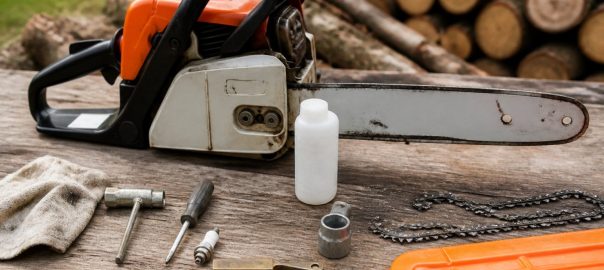
Gather these items first. Ten minutes of prep saves days of return shipping.
- Your chainsaw, cleaned and within reach
- The guide bar and old chain, if you have them
- A tape measure or ruler
- Digital or vernier calipers for accurate gauge readings
You will also need the seller’s product page open. Have their contact details handy too, because the final step involves asking a direct question.
Safe Work Australia guidance on chainsaw operation and maintenance notes that well-maintained cutting equipment reduces injury risk. Correct parts are part of that maintenance picture, not an optional extra.
Step 1: Confirm Chainsaw Chain Compatibility by Model
Start with the saw itself. Chainsaw chain compatibility by model is the foundation of every other check, because a chain that fits one 50cc saw often will not fit another of the same size.
Reading the model and serial number on your saw
Look for the model plate on the crankcase or recoil housing. It usually sits near the rear handle or under the air filter cover.
The serial number tells you the production run. Manufacturers sometimes change bar mounts or sprocket setups mid-model, so a serial number helps a seller pin down the exact variant.
If the plate is worn or missing, check the operator’s manual or the sticker on the guide bar.
Step 2: How to Identify Chainsaw Chain Pitch and Gauge
Two measurements decide whether a chain fits your bar: pitch and gauge. Get these wrong and the chain will not seat, or worse, it will run dry and overheat.
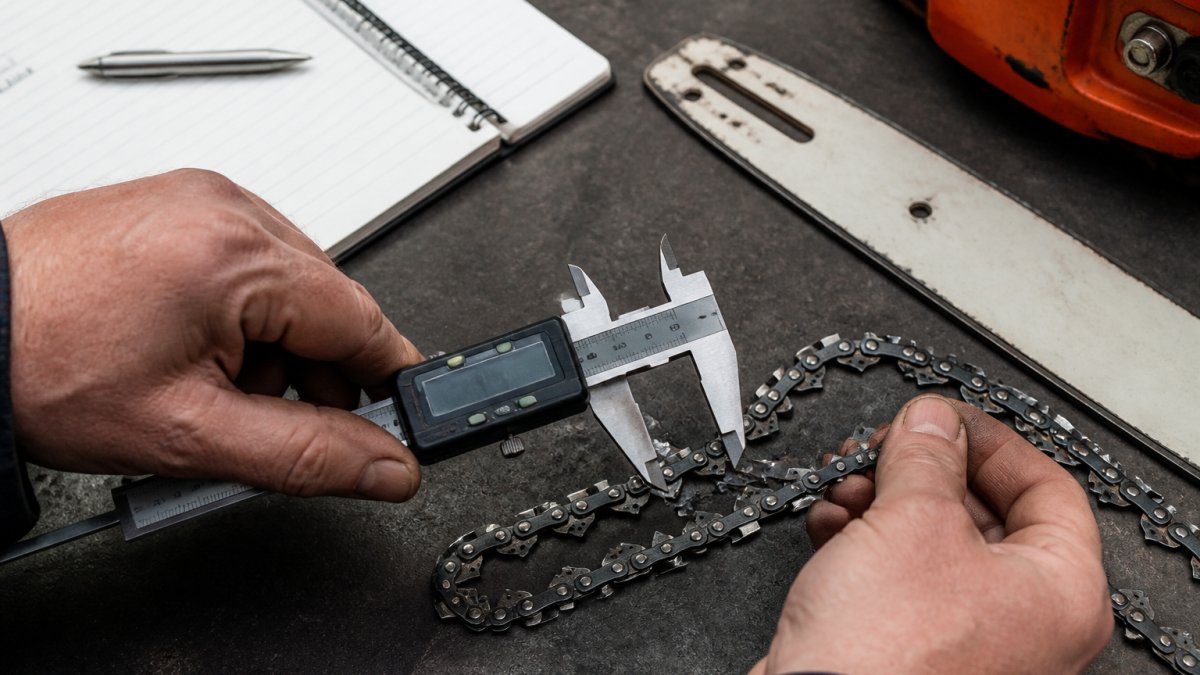
Chain pitch is the distance between any three consecutive rivets, divided by two. Chain gauge is the thickness of the drive link where it sits in the bar groove.
Counting drive links and matching bar length
Count the drive links, meaning the teeth on the inside of the chain loop that run in the bar groove.
Then measure your bar. Bar length is measured from the base to the cutting tip along the flat of the bar, not the overall length.
Record three numbers: pitch, gauge, and drive link count. Those three, plus bar length, form your chain’s identity.
Step 3: Chainsaw Part Number Lookup and Reading Chain Markings
Most chains carry their specs stamped on the drive links or printed on the box.
Look for a sequence like “3/8 LP” or a number such as “91” on the tie strap or drive link.
Cross-check the stamped code against the seller’s listing. If the listing shows a different code, stop and query it. Part numbers can look similar while describing completely different chains.
Step 4: Distinguishing Compatibility From Chainsaw Parts Availability
This is the step most buyers skip, and it causes the most pain. A part can be perfectly compatible and still be unavailable.
Compatibility answers: does this part fit my saw? Availability answers: does the seller hold it right now, in a warehouse, ready to ship?
Many product pages blur the line.
Ask yourself three questions before ordering:
- Does the page show a live stock status, or just “add to cart”?
- Is there a shipping estimate with a real date?
- Can I contact a human to confirm?
If any answer is unclear, treat the part as unavailable until proven otherwise.
Step 5: Confirming Stock With the Seller and Checking Online Inventory
Online inventory status has real limits. A website might update stock hourly, or not at all. The only reliable confirmation comes from a person. This is the step competitors skip, and it is the one that decides whether your saw runs this week or sits idle.
What online stock labels actually mean
Before you call anyone, read the label on the product page carefully. The same words mean different things at different sellers.
- In stock, the seller claims the item is on a shelf. It does not tell you how many, whether they are reserved for other orders, or whether the count is live. Treat it as a claim, not a fact.
- Limited stock, usually means one or two units, often the display item or a returned unit. Ask whether it is new, boxed, and complete.
- Available to order, the item is not on the shelf. It will be ordered from a supplier. Ask for the supplier lead time in writing, not the generic estimate on the page.
- Pickup today, only meaningful if the store’s stock feed is live. Call the store directly and ask them to physically put their hand on the part before you drive over.
A common pattern is that stock feeds update overnight, so a part shown as in stock at 9am may already be sold. If the listing is uncertain, assume it is unavailable until a person confirms otherwise.
The questions to ask a seller
Have these details ready before you contact anyone: your saw’s model and serial number, the exact part number, the quantity you need, and whether you will accept a superseded or substitute part number. Then ask these questions directly:
- “Do you physically have this part in stock today, and how many units?”
- “Is the stock count live, or updated overnight?”
- “Will it dispatch today, and what is the cut-off time?”
- “Is this part new, recycled, or a returned unit?”
- “Has this part number been superseded? If so, what is the current number?”
- “Can you reserve it under my name until I pay?”
- “Can you confirm all of this by email?”
A good seller will answer without hesitation. If they dodge the question, that tells you something. Request written confirmation by email before you pay, and keep that email until the part arrives.
Why a part can fit but still be unavailable
Compatibility and availability are separate questions. A chain can match your saw’s pitch, gauge, and drive link count perfectly and still be unavailable because it is backordered, discontinued, or listed under a substitute part number.
Australian Competition and Consumer Commission guidance on consumer guarantees sets out your rights when goods are delayed or not as described. Knowing them helps if an “in stock” item turns out to be a backorder.
|
Check |
What to Confirm |
Red Flag |
|---|---|---|
|
Compatibility |
Pitch, gauge, drive links, bar length |
Vague “fits many models” |
|
Part number |
Stamped code matches listing and packet |
No code shown |
|
Stock status |
Live indicator plus staff confirmation |
“Add to cart” only |
|
Stock count |
Number of units on hand |
“Limited stock” with no number |
|
Shipping |
Real dispatch date and cut-off time |
No estimate given |
|
Confirmation |
Written reply by email |
Verbal only, no record |
Common Mistakes to Avoid When Checking Part Stock
The same errors trip up buyers again and again. Watch for these, then read on for what to do when the part you need is genuinely unavailable.
- Trusting a green “in stock” badge. Many sites show this by default, not from live data. Confirm with a person.
- Skipping the drive link count. Pitch and gauge alone do not guarantee a fit.
- Measuring the whole bar. Measure to the cutting tip, not the full length.
- Ordering from a listing with no part number. You cannot verify what you are buying.
When the part is unavailable: your options
A part that fits your saw can still be unavailable. Before you substitute anything, work through these options in order.
- Ask for a restock estimate in writing. A good seller will give you a date range, not a vague “soon”. If they cannot, treat the part as indefinitely unavailable.
- Ask whether the part number has been superseded. Manufacturers routinely replace a part number with a newer one that fits the same saw. Ask the seller to confirm the superseded number and that it is a direct replacement, not an alternative.
- Ask about compatible replacements. A different brand or profile may fit, but only if pitch, gauge, drive link count, and bar length all match. Confirm each number, not just the model fit.
- Consider recycled or used parts for non-critical components. Ask for photos of the actual part, the stamped number, and the wear on the drive links or bar groove.
- Widen the search to other sellers who list the same part number. Compare the stock label and call to confirm, because a listing that looks identical may be a different variant.
When not to substitute a safety-critical component
Some parts should never be swapped for a “close enough” alternative. Chain, guide bars, sprockets, and any component that affects chain tension or cutting control are safety-critical.
Safe Work Australia guidance on chainsaw operation and maintenance notes that well-maintained cutting equipment reduces injury risk.
At Chainsaws R US, we stock an extensive range of new and recycled chainsaw parts and ship Australia-wide.
Frequently Asked Questions
How do I check whether a chainsaw part is in stock?
Start by confirming the exact part number for your saw model, then check the seller’s product page for a live stock status rather than a generic ‘available’ label. Look for a specific quantity or dispatch estimate, and follow up with a phone call or email to confirm before paying. Treat online inventory as a guide only: ask the seller to physically check the shelf and give you a dispatch date. This is the surest way to verify chainsaw part stock and avoid a delayed project.
How can I confirm a chainsaw chain fits my saw?
Match four things: chain pitch, gauge, number of drive links and guide-bar length. Find your saw’s model and serial number, then check the bar’s markings and count the drive links on your old chain. Cross-reference these against the replacement chain’s part number. A product finder or a call to the seller can confirm chainsaw chain compatibility by model. Never assume a chain listed as ’16 inch’ will fit, because bar mount and drive-link count vary between saws.
What information do I need to identify a chainsaw replacement part?
Gather the saw’s make, model and serial number, the part number stamped on the failed component, and photos of the part from a few angles. For chains and bars, also note pitch, gauge, drive-link count and bar length. For sprockets, record the tooth count and mount style. With these details a chainsaw part number lookup becomes straightforward, and the seller can confirm both fit and current stock without guesswork.
What should I do if the part I need is unavailable?
Ask the seller for a realistic restock date or a compatible alternative, such as a recycled part in good condition or an equivalent brand that meets the same specifications. Confirm the alternative’s pitch, gauge and drive-link count before ordering. If timing is critical, ask whether the seller can source the part from another warehouse or supplier. Always get the availability commitment in writing, including a dispatch estimate, so you can plan around the delay.
A delayed part can stall an entire job, and a wrong part is worse. Confirm compatibility, verify the part number, then insist on written stock confirmation before you pay. Chainsaws R US offers an extensive range of new and recycled parts, Australia-wide shipping, and a satisfaction guarantee, so you can order with confidence. Get started with Chainsaws R US and keep your saw cutting when it matters.